

 Contact Us
Brushed vs Brushless DC Motors:
Which is Best for your Application?
 Download White Paper
BRUSHED MOTORS: TECHNICAL OVERVIEW
Construction and Components: A brushed motor consists of several key components
- Armature: The armature is the rotating part of the motor and typically comprises a shaft with stacked steel laminations with windings around it.
- Commutator: The commutator is a split, cylindrical metal ring mounted on the motor‘s rotating shaft. It acts as a mechanical rectifier, reversing the direction of current flow in the armature windings as it rotates
- Carbon Brushes: Carbon brushes are carbon-based conductive elements that maintain electrical contact with the commutator. They are usually spring-loaded and slide against the commutator as it rotates, delivering electrical current to the armature windings.
- Magnets: Multiple sets of permanent magnets are placed inside the housing. This allows for the electrified
coils to react to the static magnetic field and rotate the armature.

- When an electric current is applied to the brushes, it flows through the armature windings, creating a magnetic field around the armature
- The magnetic field interacts with the stationary field magnets (permanent magnets or electromagnets) located in the motor‘s housing, causing the armature to rotate.
- As the armature rotates, the brushes come in contact with the next commutator pair which will energize the adjacent motor winding and continue to rotate the shaft. This process continues until the power source is removed and the brushes no longer pass current to the commutator.
Efficiency and Performance Characteristics: Brushed motors have some distinct efficiency and performance characteristics
- Limited Efficiency: Due to the friction between the brushes and commutator, brushed motors tend to have lower efficiency compared to brushless motors. This friction causes energy losses as heat, reducing overall efficiency.
- Voltage Drop: Brushed motors may experience a voltage drop across the brushes and commutator, leading to reduced performance, especially at higher speeds and loads
- Speed Control: Brushed motors can be easily speed-controlled by varying the input voltage, making them suitable for applications requiring variable speed operation. By using an external controller with suitable firmware, the motor can be controlled precisely with a PLC and is ready for Industry 4.0.

|
|
- Small houshold applicances (e.g., electric shavers, fans)
- Power tools (e.g., drills, circular saws)
- Toys and hobbyist applications (e.g., remote-controlled cars, model trains)
- Automotive applications (e.g., windshiled wiper motors, adjusteable spoiler)
- Building Automation (e.g., elevator doors, building doors)
- Agriculture (e.g., seedersa, fertilizers)
- Simple industrial machinery (e.g., conveyor belts, medical pumps)
Brushed motors have been a workhorse in the electric motor industry for many years. Their simple design, affordability, and ease of control have made them suitable for a wide range of applications. However, advancements in technology have led to the rise of brushless motors, which offer improved efficiency and performance. While brushed motors continue to serve in certain niche applications, brushless motors have become more prevalent in many industries due to their characteristics.

BRUSHLESS MOTORS: TECHNICAL OVERVIEW
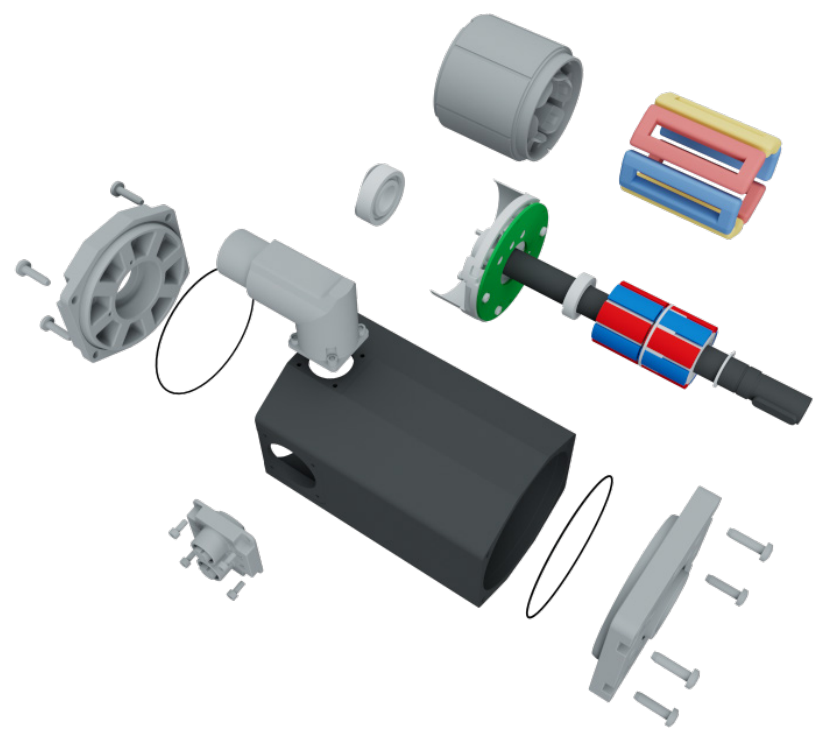
Construction and Components: A brushless motor consists of the following key components
- Rotor: The rotor is the rotating part of the motor and typically comprises permanent magnets attached to the motor‘s shaft or a magnetic hub.
- Stator: The stator is the stationary part of the motor and houses the motor‘s stator windings. The stator windings are typically three-phase, but two and five-phase configurations are also available in certain applications.
- Electronic Controller: The electronic controller, often a microcontroller or specialized motor controller, manages the flow of current through the stator windings based on feedback from sensors (e.g., Hall effect sensors or encoders).

- The controller receives feedback from hall sensors, detecting the position and speed of the rotor.
- Based on this feedback, the controller commutates the stator windings, sequentially energizing the appropriate phases to create a rotating magnetic field. One side of the winding pair becomes a positive pole while the other becomes a negative pole.
- The rotating magnetic field interacts with the permanent magnets on the rotor, causing the rotor to turn.
- As the rotor magnet approaches the charged magnetic pole, the next winding pair becomes energized.
Efficiency and Performance Characteristics: Brushless motors offer several key efficiency and performance characteristics
- High Efficiency: BLDCs are more efficient than brushed motors due to the absence of brushes and commutators, leading to reduced energy losses and heat generation.
- Smooth Operation: The absence of physical brushes results in smoother operation and less electromagnetic interference, making brushless motors ideal for precision applications.
- Variable Speed Control: Brushless motors provide precise speed control through the electronic controller, enabling smooth and accurate speed regulation.
- High Torque-to-Weight Ratio: BLDCs offer a high torque-to-weight ratio, making them suitable for applications with weight constraints.
|
|
- Aerospace and aviation (e.g., drones, aircraft actuators)
- Automotive (e.g., electric vehicles, power steering systems)
- Industrial automation (e.g., robotics, CNC machines, AGVs, logistic shuttles, packaging lines)
- Building Automation (e.g., access gates)
- Agriculture (e.g., farming robots, seeders)
- Consumer electronics (e.g., computer fans, hard disk drives)
- Renewable engergy (e.g., wind turbines, solar tracking systems)
BLDCs represent a significant advancement in electric motor technology, providing higher efficiency, smoother operation, and improved performance compared to brushed motors. Their precise control, reduced maintenance requirements, and longer lifespan have made them increasingly popular across various industries and applications. As technology continues to evolve, brushless motors are expected to become even more prevalent in various fields due to their superior characteristics and benefits.
ENERGY CONSUMPTION AND COST IMPLICATIONS
- Battery-Powered Devices: In battery-operated devices, such as cordless power tools or electric vehicles, energy efficiency directly affects the runtime and overall battery life. Brushless motors‘ higher efficiency translates to longer operating times and increased battery life, making them the preferred choice for many battery-powered applications.
- Industrial Automation: In industrial applications, where motors run continuously or for extended periods, the lower energy consumption of brushless motors can lead to substantial cost savings over time.
- HVAC Systems: HVAC (Heating, Ventilation, and Air Conditioning) systems often require motors for fans and pumps. Employing brushless motors can improve the overall efficiency of these systems, resulting in reduced energy consumption and lower operating costs.
While brushless motors offer energy efficiency benefits, they generally have a higher upfront cost compared to PMDC motors. However, in applications with high utilization and extended operation, the energy savings over time can offset the initial investment, making brushless motors more cost-effective in the long run. For applications where energy efficiency, longer battery life, and reduced operating costs are crucial, brushless motors offer a clear advantage and are becoming increasingly popular in various industries. The choice between brushed and brushless motors should be based on specific application requirements, budget constraints, and long-term energy efficiency goals.
PERFORMANCE COMPARISON
Power-to-Weight Ratio:
The power-to-weight ratio refers to the amount of power output a motor can deliver in relation to its weight. It is a crucial metric, especially in applications where weight constraints are significant, such as aerospace, automotive, and robotics. Brushed motors generally have a lower power-to-weight ratio compared to brushless motors. The presence of brushes and a commutator adds weight to the motor, limiting its ability to deliver high power output in a compact and lightweight package. As a result, brushed motors may not be the ideal choice for weight-critical applications where maximizing power output while minimizing weight is essential. Brushless motors excel in power-to-weight ratio due to their streamlined design. The absence of brushes and commutators results in reduced weight, enabling brushless motors to deliver higher power output relative to their weight. This characteristic makes brushless motors highly advantageous in weight-constrained applications, where they can provide superior performance and efficiency.
Torque Performance:
Torque is the rotational force that a motor generates, and torque performance is crucial for applications that require high starting torque, precise control, and constant torque at various speeds. Brushed motors typically offer high starting torque, which makes them suitable for applications requiring frequent starts and stops. However, their torque performance tends to decrease at higher speeds due to voltage drop and brush limitations. This limitation restricts their use in applications requiring constant and precise torque control at various speeds. Brushless motors exhibit excellent torque performance throughout their entire speed range. The electronic controller in brushless motors enables precise control over the stator windings, resulting in consistent torque output across various operating speeds. This characteristic makes brushless motors highly versatile and well-suited for applications where consistent and precise torque control is crucial, such as robotics, industrial automation, and electric vehicles.
MAINTENANCE & RELIABILITY
Brushed Motors (PMDC Motor)
Maintenance:
- Brushed motors require regular maintenance due to the wear and tear on the brushes and commutator. Over time, the brushes can wear down, become misaligned, or even break, leading to reduced motor performance and efficiency.
- The commutator, being in direct contact with the brushes, can also experience wear and arcing, which can lead to increased electrical noise and reduced motor lifespan.
- Regular maintenance involves inspecting and replacing brushes or the motor itself as needed.
Reliability:
- PMDC motors have a limited operational life due to their maintenance requirements and the potential for brush-related issues.
- With high-duty cycle applications in harsh environments, brushed motors may experience reduced reliability and increased downtime due to the need for frequent maintenance and replacements.
Environmental Considerations:
PMDCs, with their potential for brush and commutator wear, may produce more electrical noise and electromagnetic interference (EMI) compared to brushless motors. This can be a concern in applications where EMI could affect sensitive electronic devices nearbyBrushless Motors (BLDC Motor)
Maintenance:
- Brushless motors require significantly less maintenance compared to brushed motors. Since there are no brushes and commutators, there are no brush-related wear issues to address.
- The electronic controller may require occasional inspection, but it generally has a longer lifespan and is less prone to failure than brushes and commutators in brushed motors.
Reliability:
- BLDCs are known for their higher reliability due to their simplified design and reduced wear components.
- The absence of brushes and commutators eliminates common failure points, leading to longer motor lifespans and reduced maintenance needs.
- Brushless motors are better suited for continuous operation in demanding applications, making them a reliable choice for industries where uptime and reliability are crucial.
Environmental Considerations:
Brushless motors with their smoother operation and lack of brush-related issues generally produce less EMI, making them suitable for applications with stringent electromagnetic compatibility (EMC) requirements.POINTS TO REMEMBER FOR THE SELECTION PROCESS
Application Requirements
If the application requires precise speed and torque control at various speeds, brushless motors are often a better choice due to their ability to provide consistent torque performance throughout the speed range. For applications with frequent stars and stops, brushed motors may be suitable, as they generally offer higher starting torque and simpler speed control through voltage regulation.
Efficiency and Power Consumption
If energy efficiency and reduced energy consumption are crucial factors, brushless motors are preferred due to their higher efficiency compared to brushed motors. In battery-power applications, such as electric vehicles or portable tools, the energy efficiency of brushless motors can significantly extent the battery life and increase the overall operating time.
Maintenance and Reliability
For applications requiring minimal maintenance and extended lifespan, brushless motors are the better choice. Their design with no brushes and commutators reduces wear and provides higher reliability and reduced downtime. Brushed motors, while simpler in construction, required regular maintenance and may have a shorter lifespan due to brush and commutator wear.
Cost Considerations
Brushed motors typically have a lower upfront cost compared to brushless motors. However, when considering the total cost of ownership over the motor’s lifespan, including maintenance and energy consumption, brushless motors may become more cost-effective in the long run. Major factors will be the motor’s operational time (duty cycle) and ease of access for maintenance.
Power-to-Weight Ratio
In weight critical applications, such as aerospace or robotics, brushless motors offer a high-power density, making them more suitable for achieving high power output in compact and lightweight designs.
Electromagnetic Interference (EMI)
If the application requires reduced electromagnetic interference, brushless motors are generally preferred due to their smoother operation and lack of brush-related issues.
Industrial Internet of Things (IIoT)
IIoT applications often require precise control over motor speed and torque. Brushless motors offer superior control capabilities, enabling smooth and accurate adjustments through their electronic controllers. Additionally, brushless motors‘ compatibility with IoT integration and communication protocols facilitates data collection and remote monitoring, enabling predictive maintenance and enhanced control over the entire IIoT system.
Industry Trends
Brushless motors have been gaining popularity in various industries due to their superior performance, efficiency, and reliability. Industry trends may lean towards brushless motors in many applications. This does not mean that every application should be outfitted with state-ofthe-art brushless motors, however, as the market for simple and cost-effective motors is not going anywhere.