

 Contact Us
EtherNet/IP: Bridging the Gap between Manufacturing and Ethernet Technology
 Download White Paper
1. A little background on the EtherNet/IP protocol
EtherNet/IP is a groundbreaking technology that combines the
reliability of flexibility of Ethernet with the industrial protocols
required in manufacturing and automation processes. This
article explores the concept of EtherNet/IP, its history, key
components, and its impact on modern manufacturing. As
industries increasingly adopt automation and Industrial Internet
of Things (IIoT) solutions, EtherNet/IP emerges as a vital
communication protocol, seamlessly connecting factory devices
and equipment to Ethernet network. We will also explore some
applications that can benefit from this technology and how
stare-of-the-art BLDC motors with built-in controllers allow for
easy integration into automation processes.
In the rapidly advancing world of industrial automation, communication plays a pivotal role in ensuring seamless and efficient operations. Traditional fieldbus systems have been employed for decades, but their limitations in terms of speed, bandwidth, and scalability have spurred the need for an alternative solution. EtherNet/IP, developed by Rockwell Automation and the Open DeviceNet Vendors Association (ODVA) bridges this gap, bringing the benefits of Ethernet technology to the factory floor.
In the rapidly advancing world of industrial automation, communication plays a pivotal role in ensuring seamless and efficient operations. Traditional fieldbus systems have been employed for decades, but their limitations in terms of speed, bandwidth, and scalability have spurred the need for an alternative solution. EtherNet/IP, developed by Rockwell Automation and the Open DeviceNet Vendors Association (ODVA) bridges this gap, bringing the benefits of Ethernet technology to the factory floor.
EtherNet/IP has its roots in two separate protocols –
Ethernet and ControlNet. In the late 1990s, these protocols were
combined to create a more efficient and scalable solution,
resulting in the birth of EtherNet/IP. Since then, it has been
widespread adoption due to its robustness, versatility, and ease
of implementation. ODVA has now become the sole governing
body over this technology and provides industry standards as
well as educational material and conferences.
EtherNet/IP is an industrial protocol that facilitates real-time data exchange between devices and control systems in an Ethernet network. It leverages standard Ethernet and Internet Protocol (IP) technology, enabling seamless integration of factory automation systems with IT networks. This integration is a significant advantage in today’s connected world, as it provides a common platform for data exchange and analysis across the enterprise. This greatly improves visibility and data-based decision making for predictive maintenance and improvements in efficiency.
EtherNet/IP is an industrial protocol that facilitates real-time data exchange between devices and control systems in an Ethernet network. It leverages standard Ethernet and Internet Protocol (IP) technology, enabling seamless integration of factory automation systems with IT networks. This integration is a significant advantage in today’s connected world, as it provides a common platform for data exchange and analysis across the enterprise. This greatly improves visibility and data-based decision making for predictive maintenance and improvements in efficiency.
2. What are the key components of EtherNet/IP?
Common Industrial Protocol:
At the heart of EtherNet/IP is the Common Industrial Protocol (CIP), which provides the communication structure and services necessary for seamless and quick data exchange. CIP encompasses four sub-protocols – CIP Application Protocol (CIP-AP), CIP Safety, CIP Sync, and CIP Motion – each tailored to specific needs of the industrial automation industryObject Model:
EtherNet/IP uses an object-oriented model to represent various devices and data on the network. Each device presents its data and functionally as objects, making it easier for other devices to understand and interact with them. This standardized approach enhances inter-operability and simplifies device integration.Explicit and Implicit Messaging:
EtherNet/IP supports both explicit and implicit messaging.
Explicit messaging involves direct communication between
devices and control systems using a request-response model,
while implicit messaging enables periodic data exchanges
between devices with the need for explicitly requests.

3. The advantages of EtherNet/IP
Scalability and Flexibility:
EtherNet/IP provides a scalable solution, capable of accommodating large networks with thousands of devices. It also supports various topologies, including bus, star, ring, and mesh configurations, offering flexibility in designing automation networks. We will take a closer look at these topologies shortly.High-Speed Data Transfer:
As an Ethernet-based protocol, EtherNet/IP offers high data transfer rates, allowing real-time monitoring and control of industrial processes. This capability is crucial for time-sensitive applications, such as robotics and precision manufacturing.Seamless Integration with IT Networks:
EtherNet/IP’s compatibly with standard Ethernet and IP technology allows perfect integration with IT systems, facilitating data exchange between factory automation and enterprise-level applications. This creates opportunities for device monitoring, status-updates, and predictive maintenance for smart automation devices.
EtherNet/IP has revolutionized modern manufacturing by
enabling improved productivity, efficiency, and predictive
maintenance. The protocol’s real-time data exchange and
integration with IT networks empower manufactures with
valuable insights into production processes, leading to data-drive
decision making and optimized operations. While EtherNet/IP
offers numerous benefits, challenges such as security concerns
and legacy system compatibility still need to be addressed.
However ongoing advancements in technology and standards
are expected to address these challenges and further enhance
the adoption of EtherNet/IP in the manufacturing domain.
4. EtherNet/IP Protocols are like Onions... they have layers
The EtherNet/IP protocol stack follows the OSI (Open Systems
Interconnection) model, which consists of seven layers. These
layers work together to facilitate communication between
devices over EtherNet/IP networks. Let’s explore each layer:

5. Topologies
To enable efficient data transmission, it is crucial to understand
the different EtherNet/IP topologies that govern network
configurations. Let’s take a look into the fundamental topologies
and explore real-world examples to gain a comprehensive
understanding of their applications and advantages.
Example - Bus topology finds relevance in industrial applications, such as factory floor automation. Sensors, motors, actuators are connected in a linear fashion, sending data to a central controller.

Example - Metropolitan Area Networks (MANs) may implement a ring topology to interconnect multiple office buildings within a city. The ring configuration ensures efficient data transmission across the network.

Bus Topology:
The bus topology is one of the simplest and oldest EtherNet/ IP configurations. In this setup, all devices are connected to a single main cable, resembling a straight line or a bus. Data transmission occurs through the cable, where each device listens to the data being sent. While this topology is straightforward and easy to implement, it does have limitations. If the main cable is damaged, the entire network may go down, and adding or removing devices can be challenging.Example - Bus topology finds relevance in industrial applications, such as factory floor automation. Sensors, motors, actuators are connected in a linear fashion, sending data to a central controller.
Ring Topology:
In a ring topology, each device is connected to precisely two other devices, forming a circular loop. Data travels in one direction along the ring until it reaches its intended destination. While this setup ensures consistent data flow and relatively simple cabling, a single malfunctioning device can disrupt the entire network. Error detection in case of a defective cable in the loop is very simple and can be mitigated easilyExample - Metropolitan Area Networks (MANs) may implement a ring topology to interconnect multiple office buildings within a city. The ring configuration ensures efficient data transmission across the network.
Star Topology:
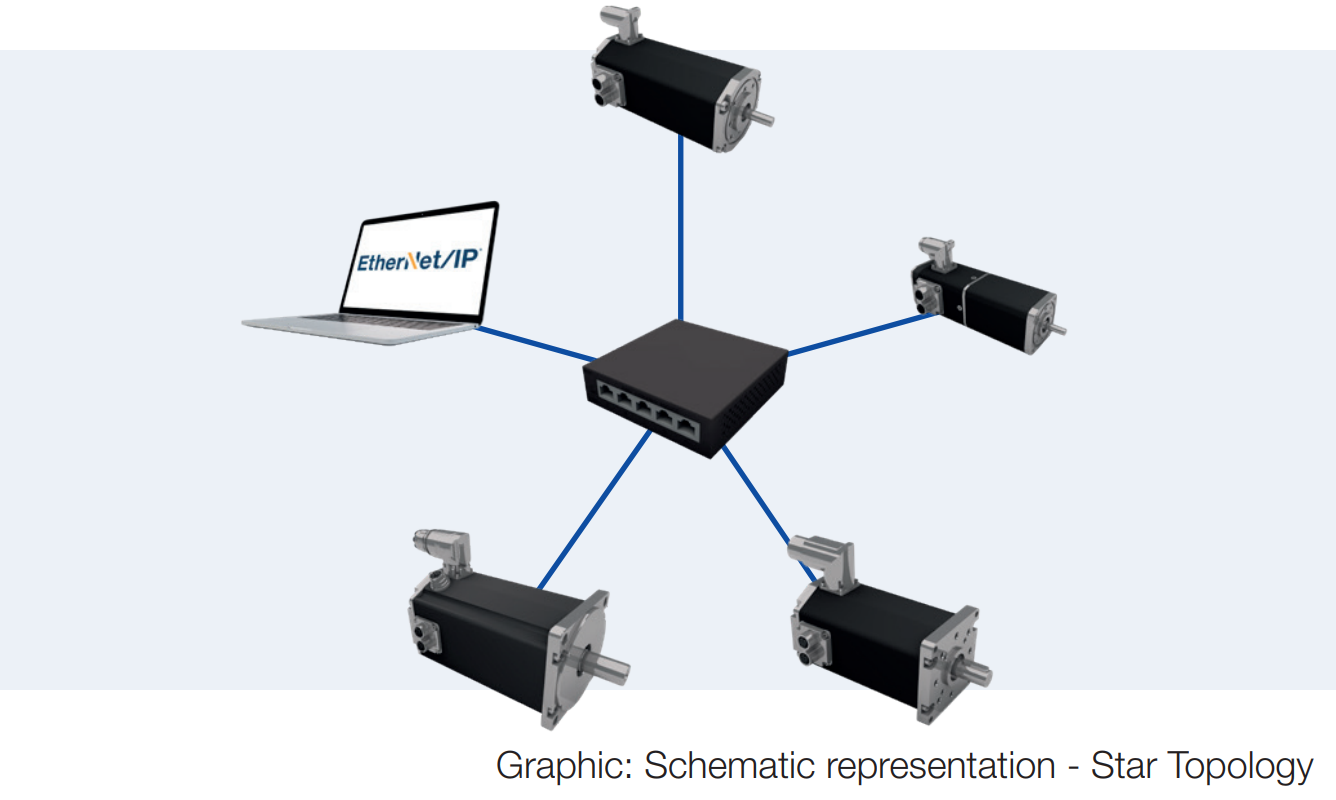
The star topology features a central hub or switch to which all devices are directly connected. Each device communicates with others by transmitting data through the central hub. This setup offers advantages like easy device management, scalability, and fault isolation. However, it comes with the drawback that if the central hub fails, the entire network might become nonfunctional.Example - Local Area Networks (LANs) in offices or educational institutions often use a star topology. The switch acts as the central hub, linking computers, printers, and other devices together.
Mesh Topology:
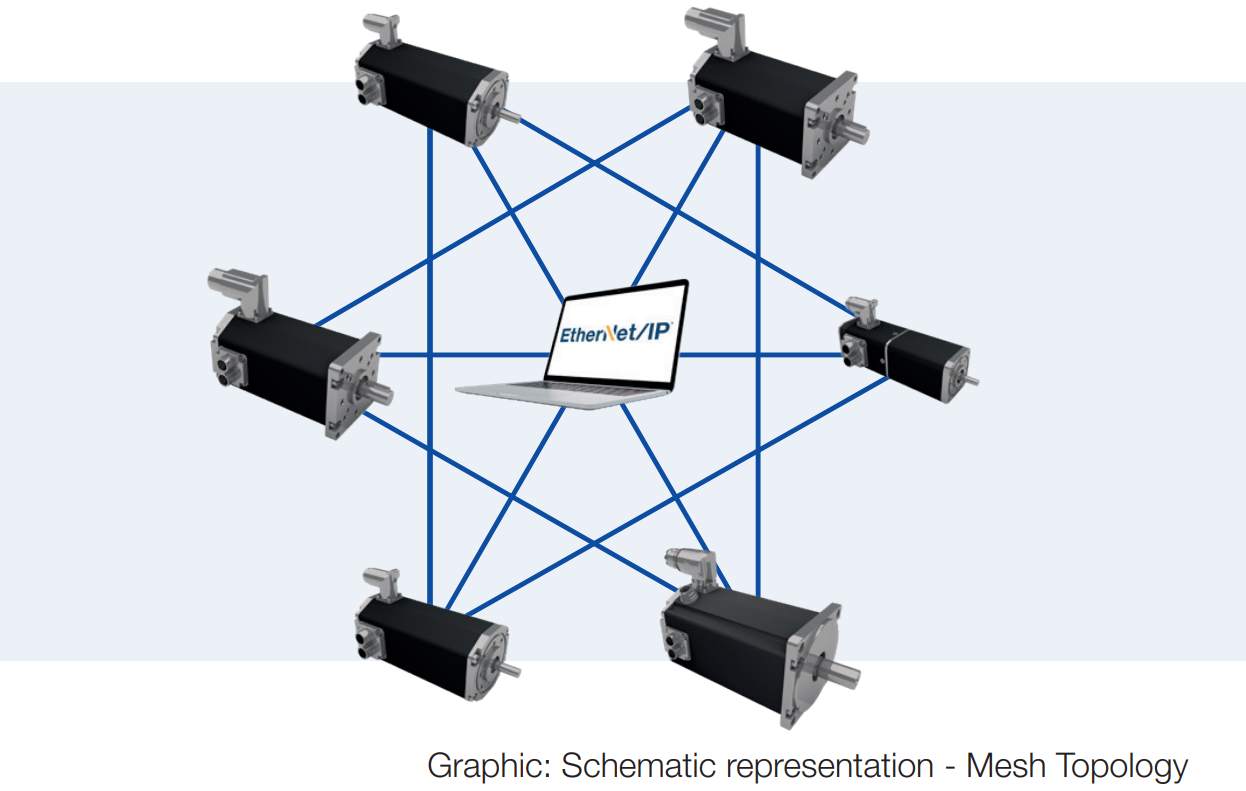
The mesh topology takes redundancy and fault tolerance to new heights. Each device in the network is connected to every other device, forming a robust web of connections. This structure ensures multiple paths for data to travel, minimizing the risk of network failure. While EtherNet/IP does not support true mesh topologies, some industrial automation applications use a hybrid approach to achieve a combination of mesh and star topologies. As an example, a factory might use multiple star networks connected in a mesh like configuration to create redundancy. Within each set of star connections, EtherNet/IP would still function using a standard star topology with switches.Example - Large-scale data centers and critical infrastructure like hospitals, airports, and warehouses may use a partial mesh topology to ensure uninterrupted communication between various departments and facilities.
6. Brushless Motors with EtherNet/IP Capabilities
Brushless (BLDC) motors (electronically commutated motors)
are a type of synchronous electric motor that offers several
advantages over traditional brushed DC motors. The absence of
brushes in BLDC motors reduces friction and wear, resulting in
increased motor efficiency and extended service life. The rotor
of a BLDC motor contains permanent magnets, and the stator
features electronically controlled windings. This design ensures
precise and smooth motor operation, making BLDC motors
an ideal choice for applications demanding high precision
and variable speeds. When combined with EtherNet/IP
communications, they create a powerful synergy that enhances
automation capabilities and optimizes industrial operations.

»Here are 4 reasons to use smart brushless
motors with EtherNet/IP protocols:
- Precise and Centralized Control
By integrating BLDC motors with EtherNet/IP, industrial automation systems can achieve centralized control. The protocol allows precise coordination and synchronization of multiple BLDC motors, leading to smooth and efficient motion control. Centralized control also simplifies parameter adjustments and reduces the need for extensive cabling, enhancing system flexibility and scalability. When combined with Dunkermotoren’s BG dPro brushless motors, even less devices and cabling is needed as the controller is built into the motor housing. - Real-time Monitoring and Diagnostics
EtherNet/IP enables real-time monitoring of critical parameters of BLDC motors, such as speed, torque, and temperature. This information allows operators to detect anomalies and potential faults early, facilitating predictive maintenance strategies. With actionable insights from real-time data, downtime is minimized, and productivity is optimized. Dunkermotoren offers its nexofox services, which enables users to monitor, parameterize, and control their brushless motors remotely anywhere in the world. - Seamless Integration
EtherNet/IP follows standard networking protocols, promoting interoperability among different devices and vendors. BLDC motors from various manufacturers can be effortlessly integrated into the industrial automation system, reducing integration challenges and costs. This allows for easy upgrades to existing systems and selecting the best performance options from multiple motor suppliers. - Remote Access and Control
EtherNet/IP’s inherent capability for remote access and control empowers engineers and operators to monitor and adjust BLDC motor parameters from anywhere within the network. This remote accessibility enhances operational efficiency, as it reduces the need for physical presence near each motor. Once again, services like nexofox enable machine control and adjustment at your fingertips to make data-driven decisions in real-time.
Motor manufacturers often provide external controllers in
various protocols to operate their motors. These controllers
act as the node in the network that handles communication
and packaging of application data. External controllers can
work with any manufacturer’s motor as long as they are able
to handle the motor’s power requirements. Unfortunately, they
require additional design considerations as they add another
device that must to be mounted on the machine and complicate
cabling as they must connect the motor to the network. Some
manufacturer’s like Dunkermotoren have started building smart
BLDC motors with integrated controls including EtherNet/IP
functionality. This means that the controller is already built into
the motor housing and therefore reduces footprint and creates
a simpler machine design.

7. Applications in Industrial Automation
AGV/AGC and AMR
Nowadays, the intralogistics sector’s use of Automated Guided Vehicles (AGV), Automated guided Cars (AGC) and Autonomous Mobile Robots (AMR) is common. EtherNet/IP fits the needs of speed and flexibility of an AGV/AGC or AMR perfectly and ensures accurate positioning in complex tasks.
More Information


Packaging and Labeling
Ethernet/IP enabled BLDC motors streamline packaging and labeling processes, ensuring consistent and reliable operation in fast-paced prodcution lines. A common use and advantage is the format adjustment of the machines. In strapping machines, different size boxes can be strapped by simply re-configuring the motors.
More Information
Machine Tools
EtherNet/IP equipped BLDC motors in CNC machines deliver high-speed and precise machining operations, improving productivity and product quality.
More Information

Material Handling
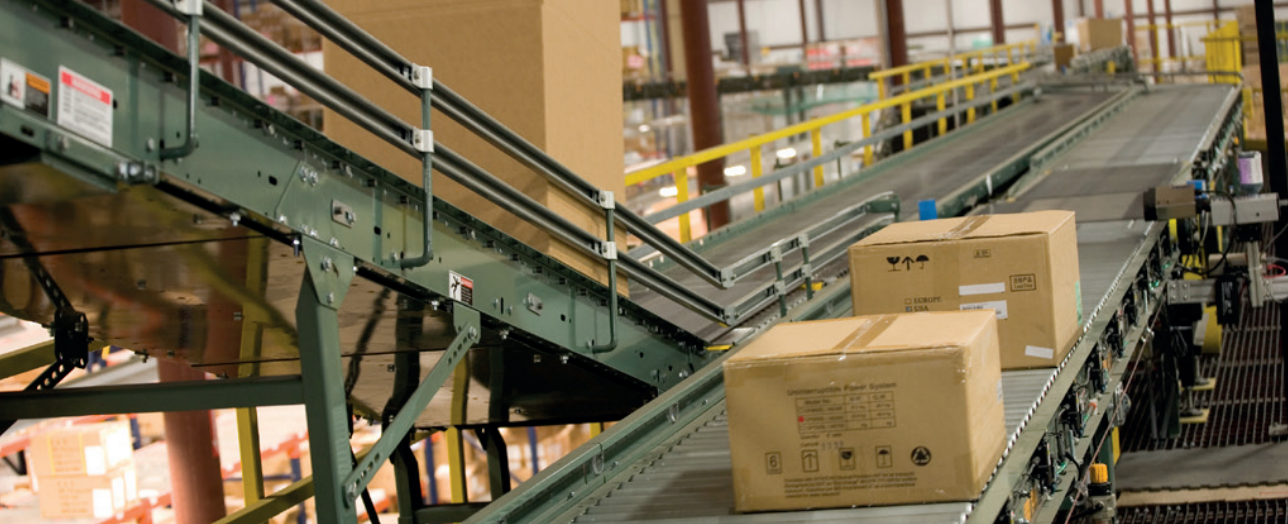
In automated conveyor systems and material handling equipment, the integration of BLDC motors with EtherNet/IP optimizes the speed and accuracy of goods transportation.
More Information
Want to find out more about motors equipped with Ethernet IP? Click here >>
Sources
EtherNet/IP Overview ODVA, Inc. - „EtherNet/IP ODVA“ - https://www.odva.org/technology-standards/key-technologies/ethernet-ip/
- accessed on August 26, 2024
CIP on Ethernet TechnologyODVA, Inc. - „CIP on Ethernet Technology“ - https://www.odva.org/wp-content/uploads/2024/04/PUB00138R8_Ethernet.pdf
- accessed on August 26, 2024
Brushless Motor Control Techniques - Krishnan, R. Permanent Magnet Synchronous and Brushless DC Motor Drives. CRC Press, 2009
- accessed on August 26, 2024
Real-Time Ethernet Communication in Industrial Automation - Wilamowski, Bogdan M., and J. David Irwin, eds. Industrial Communication Systems. CRC Press, 2011
- accessed on August 26, 2024
Sources
EtherNet/IP Overview ODVA, Inc. - „EtherNet/IP ODVA“ - https://www.odva.org/technology-standards/key-technologies/ethernet-ip/
- accessed on August 26, 2024
CIP on Ethernet TechnologyODVA, Inc. - „CIP on Ethernet Technology“ - https://www.odva.org/wp-content/uploads/2024/04/PUB00138R8_Ethernet.pdf
- accessed on August 26, 2024
Brushless Motor Control Techniques - Krishnan, R. Permanent Magnet Synchronous and Brushless DC Motor Drives. CRC Press, 2009
- accessed on August 26, 2024
Real-Time Ethernet Communication in Industrial Automation - Wilamowski, Bogdan M., and J. David Irwin, eds. Industrial Communication Systems. CRC Press, 2011
- accessed on August 26, 2024