

 Contact Us
Gantry Systems
Built for Precision, Modularity & High Force
Our Gantry Systems deliver outstanding accuracy and dynamic performance for multi-axis linear motion applications. Designed for demanding environments, they offer long-lasting reliability and maximum flexibility. 100% Made in Germany.
- Precise Positioning: Our linear motors achieve repeatability down to 6 micrometers, making them ideal for high-precision automation tasks across various industries.
- Scalable Performance: Choose from 5 modular series with motor sizes ranging from 28 mm to 80 mm and magnetic rod diameters from 11 mm to 38 mm. Each motor is available in 3–4 body lengths, allowing you to tailor force and stroke to your application.
- Robust & Versatile: Available in stainless steel versions with protection class, our Gantry Systems are built to withstand harsh environments, including washdown and cleanroom conditions.
- Long-Term Reliability: With a service life of over 20,000 km, our systems are engineered for durability and consistent performance in continuous operation.

Customization and Support
Tailored Gantry System Solutions for Maximum Flexibility
Our expert engineering team specializes in customizing Gantry Systems to meet your specific application needs. From mechanical adaptations to electronic integration, we ensure your system fits seamlessly into your machine architecture.
- Application-Specific Modifications: We offer a wide range of customization options, including shaft and rod configurations, cable lengths, connector types, and IP protection levels for hygienic or washdown environments.
- Perfectly Matched Accessories: Enhance your system with precision planetary gearboxes and power-off brakes for added safety and holding force. All components are designed for optimal compatibility with our linear motors.
- Integrated Electronics: Boost performance and simplify integration with embedded control electronics, enabling real-time feedback, diagnostics, and seamless motion control.
- Flexible Controller Options: Choose from a broad portfolio of controllers, from cost-effective Step & Direction or RS485 units to high-end Closed Loop Controllers with Industrial Ethernet and CANopen interfaces.


Get a free consultation to discuss your specific needs and find the best solution for your application.
Where Our Gantry Systems Are Used
Our Gantry Systems are trusted in high-performance environments where accuracy, repeatability, and modularity are essential. Here are six specific examples of how our systems are used in real-world applications:
Warehouse & Logistics Automation
Gantry robots are increasingly used in automated storage and retrieval systems (AS/RS), palletizing, and order picking. Their large working envelope and high payload capacity make them a cost-effective alternative to traditional robotic arms.
Semiconductor & Cleanroom Applications
In wafer handling, die bonding, and inspection, gantry systems provide ultra-clean, vibration-free motion. Their ability to operate in controlled environments makes them ideal for sensitive processes.
3D Printing & Additive Manufacturing
Gantry systems form the backbone of many industrial 3D printers, enabling layer-by-layer deposition with sub-millimeter precision. Their rigid structure and scalable design support large build volumes and complex geometries.
Packaging & Labeling
From carton forming to high-speed labeling and sealing, Dunkermotoren gantry systems enable fast, synchronized motion across multiple axes. Their modularity allows easy adaptation to different product sizes and packaging formats. .
Medical & Laboratory Automation
In diagnostics, sample handling, and imaging systems, gantry platforms provide clean, precise, and repeatable motion. Stainless steel options make them suitable for sterile and washdown environments.
Electronics Manufacturing
Dunkermotoren Gantry systems are widely used in PCB assembly, solder paste dispensing, and component placement. Their high repeatability and micrometer-level accuracy ensure consistent quality in high-speed, high-volume production environments.
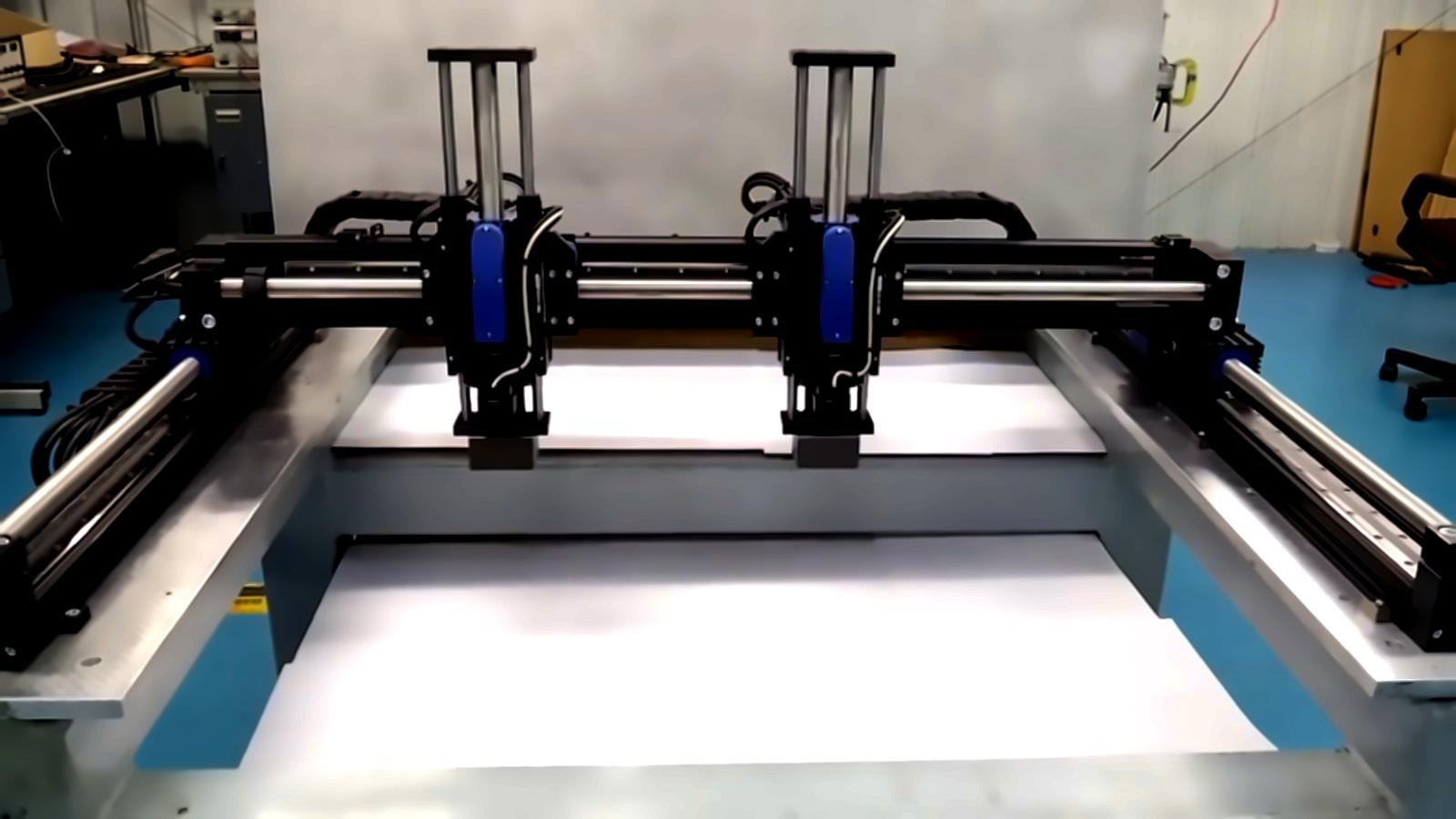
3-Axis Gantry in Action with ServoTube Technology
This video demonstrates a high-performance 3-axis gantry system built with Dunkermotoren ServoTube linear motors. The setup includes:
- Two synchronized X-axis motors (X and X’) driven by a single controller for mirrored motion,
- Two independently controlled Y-axis motors operating on the same rail, enabling parallel or asynchronous tasks,
- Two Z-axis motors with a high-rigidity configuration, ideal for vertical operations like pick-and-place, welding, sampling, or stamping.
How to Select the Right Gantry System for Your Application
Choosing the right gantry system is essential for achieving precision, stability, and efficiency in your automation or motion control project. Whether you're working in manufacturing, inspection, 3D printing, or material handling, this guide will help you make the best decision.
Step 1: Define the Application Requirements
- Payload Capacity: Determine the weight and size of the components or tools the gantry will move.
- Travel Distance: Specify the required stroke lengths for each axis (X, Y, Z).
- Cycle Time: Understand how fast the system needs to move and settle to meet your production goals.
Step 2: Choose the Right Gantry Configuration
- 2-Axis or 3-Axis: Select between XY, XYZ, or custom multi-axis configurations based on your motion needs.
- Portal vs. Cantilever: Decide on the mechanical structure that best fits your space and load distribution.
- Mounting Options: Consider floor-mounted, ceiling-mounted, or frame-integrated systems depending on your layout.
Step 3: Focus on Precision and Repeatability
- Accuracy Requirements: Define the level of positioning accuracy and repeatability your process demands.
- Smooth Motion: Look for systems with low backlash, high stiffness, and optimized motion profiles for smooth, controlled movement.
Step 4: Consider the Operating Environment
- Cleanroom or Industrial: Choose materials and finishes suitable for cleanroom, food-grade, or harsh industrial environments.
- Temperature & Contaminants: Ensure the system can operate reliably under your environmental conditions, including exposure to dust, moisture, or temperature extremes.
- Protection Options: IP-rated enclosures, bellows, and sealed bearings are available for added durability.
Step 5 Integration with Your System
- Modular Design: Our gantry systems are modular and scalable, making them easy to integrate into existing machines or production lines.
- Control Compatibility: Compatible with a wide range of motion controllers and automation platforms.
- Sensor & Tool Mounting: Easily integrate cameras, grippers, lasers, or other tools with customizable mounting options.
Step 6: Customization Options
- Tailored Dimensions: Customize stroke lengths, axis spacing, and mounting interfaces to fit your exact needs.
- Cable Management: Integrated cable chains and routing options ensure clean and safe operation.
- Add-Ons: Options include linear encoders, brakes, limit switches, and more.
Step 7: Expert Support & Consultation
Not sure which gantry system is right for your application? Our engineering team is here to help. Take advantage of our free consultation service to discuss your project and receive a tailored recommendation.
Benefits of Gantry Systems from Dunkermotoren
Precision, Scalability & Efficiency for Demanding Applications
- High Precision Across Large Workspaces: Gantry systems offer exceptional accuracy and repeatability — often down to ±6 µm — even across large travel distances. Their rigid, orthogonal axis design ensures consistent positioning throughout the entire working envelope, making them ideal for tasks like inspection, dispensing, and micro-assembly.
- Scalable for Heavy Loads and Long Travel: Unlike robotic arms, gantry systems can be scaled to span several meters while maintaining high payload capacity. This makes them perfect for applications such as battery module assembly, automated palletizing, or semiconductor wafer handling, where both reach and strength are critical.
- Superior Stability and Rigidity: Thanks to their dual-supported linear axes and bridge structure, gantry systems minimize deflection and vibration. This structural advantage ensures smooth, stable motion — even under dynamic loads — and outperforms cantilevered systems in terms of mechanical stiffness.
- Flexible Multi-Axis Integration: Gantry platforms can be configured with 2, 3, or more axes, including vertical Z-axes or rotary modules. This flexibility allows for complex motion profiles in applications like laser welding, 3D printing, or automated optical inspection.
- Cost-Effective for Large-Scale Automation: Compared to articulated robots, gantry systems offer a lower cost per unit of workspace. Their modular design reduces installation complexity and allows for easy expansion or reconfiguration, making them a smart investment for growing production lines.
- Easy Integration with Vision, Sensors & Control Systems: Modern gantry systems support seamless integration with vision systems, force sensors, and industrial controllers (e.g., EtherCAT, CANopen). This enables real-time feedback, adaptive motion, and full traceability in smart manufacturing environments.
- Predictive Maintenance: Our motors are capable of predictive maintenance, helping to identify potential issues before they become critical, ensuring continuous operation and reducing downtime.
Gantry Systems vs. Other Motion Systems
When selecting a motion system, it's essential to understand the differences between gantry systems and other common automation platforms such as articulated robots, SCARA, and delta robots. Here's a detailed comparison to help you make an informed decision:Gantry Systems (Cartesian Robots)
Advantages:
- High Precision Over Large Areas: Gantry systems offer excellent repeatability (down to ±6 µm) across large workspaces, ideal for applications like inspection, dispensing, and additive manufacturing.
- Scalability: Easily scaled in size and payload capacity — from compact lab setups to multi-meter industrial platforms.
- Structural Rigidity: Their fixed-frame design minimizes vibration and deflection, ensuring stable motion even under heavy loads.
- Cost-Effective for Large Work Envelopes: Lower cost per unit of workspace compared to robotic arms.
- Modular & Customizable: Easily configured with multiple axes, tool changers, or vision systems.
Disadvantages:
- Larger Footprint: Requires more physical space than compact robotic arms.
- Limited Flexibility: Less suited for tasks requiring complex, multi-angle articulation (e.g., welding in tight spaces).
- Setup Complexity: Installation and alignment can be more involved than plug-and-play robotic arms.
Articulated Robots (6-Axis Arms)
Advantages:
- High Flexibility: Can reach around obstacles and perform complex, multi-directional tasks.
- Compact Footprint: Ideal for space-constrained environments.
- Versatile Applications: Used in welding, painting, machine tending, and more.
Disadvantages:
- Lower Precision Over Distance: Accuracy decreases with reach due to joint tolerances.
- Higher Cost per Workspace: More expensive for large-area tasks compared to gantries.
- Complex Programming: Requires advanced control systems and safety integration.
SCARA Robots
Advantages:
- Fast & Repeatable: Excellent for high-speed pick-and-place and small part assembly.
- Compact & Efficient: Small footprint with high throughput.
- Simple Control: Easier to program than articulated arms.
Disadvantages:
- Limited Z-Axis Movement: Not ideal for tall or multi-level operations.
- Restricted Workspace: Circular work envelope limits flexibility.
- Complex Programming: Requires advanced control systems and safety integration.
Compare Motion Systems
| System Type | Advantages | Disadvantages | Typical Applications |
|---|---|---|---|
| Gantry Systems (Cartesian) |
High precision over large areas Scalable and modular High payload capacity Excellent rigidity and repeatability |
Large footprint Limited flexibility in complex 3D paths Slower than delta or SCARA in high-speed pick-and-place |
PCB assembly Laser engraving Palletizing Medical diagnostics automation |
| Articulated Robots |
High flexibility and reach Can navigate around obstacles Suitable for complex 3D tasks |
Lower precision over long distances Higher cost per workspace Complex programming and safety integration |
Welding Assembly Machine tending Automotive manufacturing |
| SCARA Robots |
Fast and accurate in 2D plane Compact footprint Simple control and integration |
Limited vertical (Z-axis) movement Restricted to planar tasks Lower payload than gantry or articulated |
Small part assembly Pick-and-place Packaging Electronics handling |
| Delta Robots |
Extremely fast and lightweight Ideal for high-speed sorting Low inertia and smooth motion |
Low payload capacity Limited working volume Complex kinematics and control |
Food packaging Pharmaceutical sorting High-speed pick-and-place |