

 Contact Us
Partial discharge of electric drive systems
Due to increasing energy efficiency measures for equipment and control systems of electrical drives, switch-mode power supplies and frequency converters are increasingly used.
Due to the converters there are higher voltage peaks which can lead to partial discharges
and thus significantly shorten the service life of electrical machines.
Partial discharge is not a continuous process. As the name implies, the electrical breakdown is not complete, but the discharge is only partial due to bridging the insulation. Only above a certain voltage the first discharges occur and after a hysteresis, at reduced voltage this effect stops again. The causes and the development of the partial discharge depend very much on the type of dielectric or insulating medium and the structural design of the insulation. Especially inhomogeneities in the insulation structure caused by foreign substances, impurities and gas cavities in the manufacturing process can favour partial discharges. Even in operating conditions, for example due to mechanical and temperature-dependent influences, deformations and vibrations, partial discharges can occur in the insulation due to the applied voltage.
The increasing demands on solid insulation systems of electronic and electrical components or equipment with compact design and with increasing switching frequencies of semiconductors require the use of insulation materials and composite materials that are free of partial discharges as well as resistant to partial discharges. This applies in particular to electrical components in variable-speed drives. The enamelled wire insulations of drives are stressed with twice the DC link voltage. One of the causes of the damaging voltage rise is the superposition of the reflecting voltage wave with the supply voltage due to the difference in impedance between cable and motor. The rectangular operating voltage with high switching frequencies produces high peak levels and steep rising edges, which together lead to the generation of partial discharges and accelerated aging of insulation systems. Partial discharge measurement technology and diagnostics are also playing an increasingly important role in monitoring product quality during production by means of type and routine testing and for estimating the service life of insulation systems. According to IEC 60270 and VDE 0434, respectively, partial discharge (PD) is defined as follows: „Locally confined electrical discharge which only partially bridges the insulation between conductors and which can but need not occur adjacent to a conductor“1
For quality control of the insulation system of electronic or electrical components and systems, short-term PD measurements can be used as non-destructive testing methods. Partial discharges can also occur in low-voltage applications, especially in electric motors. These are mainly internal partial discharges (gas discharges surrounded by a solid insulating material), which cause accelerated aging and thus weakening or failure of the insulation system due to the continuous decomposition of the insulation material.
Partial discharge is not a continuous process. As the name implies, the electrical breakdown is not complete, but the discharge is only partial due to bridging the insulation. Only above a certain voltage the first discharges occur and after a hysteresis, at reduced voltage this effect stops again. The causes and the development of the partial discharge depend very much on the type of dielectric or insulating medium and the structural design of the insulation. Especially inhomogeneities in the insulation structure caused by foreign substances, impurities and gas cavities in the manufacturing process can favour partial discharges. Even in operating conditions, for example due to mechanical and temperature-dependent influences, deformations and vibrations, partial discharges can occur in the insulation due to the applied voltage.
The increasing demands on solid insulation systems of electronic and electrical components or equipment with compact design and with increasing switching frequencies of semiconductors require the use of insulation materials and composite materials that are free of partial discharges as well as resistant to partial discharges. This applies in particular to electrical components in variable-speed drives. The enamelled wire insulations of drives are stressed with twice the DC link voltage. One of the causes of the damaging voltage rise is the superposition of the reflecting voltage wave with the supply voltage due to the difference in impedance between cable and motor. The rectangular operating voltage with high switching frequencies produces high peak levels and steep rising edges, which together lead to the generation of partial discharges and accelerated aging of insulation systems. Partial discharge measurement technology and diagnostics are also playing an increasingly important role in monitoring product quality during production by means of type and routine testing and for estimating the service life of insulation systems. According to IEC 60270 and VDE 0434, respectively, partial discharge (PD) is defined as follows: „Locally confined electrical discharge which only partially bridges the insulation between conductors and which can but need not occur adjacent to a conductor“1
For quality control of the insulation system of electronic or electrical components and systems, short-term PD measurements can be used as non-destructive testing methods. Partial discharges can also occur in low-voltage applications, especially in electric motors. These are mainly internal partial discharges (gas discharges surrounded by a solid insulating material), which cause accelerated aging and thus weakening or failure of the insulation system due to the continuous decomposition of the insulation material.
The following three conditions must be met to generate partial discharges:
- A sufficiently high electric field strength to cause ionization
- A start electron must be present
- A feedback mechanism that maintains the avalanche effect
The occurring partial discharge is a physical quantity which can be measured with the help of
different measuring methods. In the classic high-voltage test with alternating voltage, only typical
breakdowns between the damaged conductor and the motor housing are considered. Faulty insulation is therefore not detected by the high-voltage and surge voltage test. The partial discharge
measurement is able to detect insulation weaknesses. As already mentioned, partial discharge
occurs in places where there are very high voltage differences.
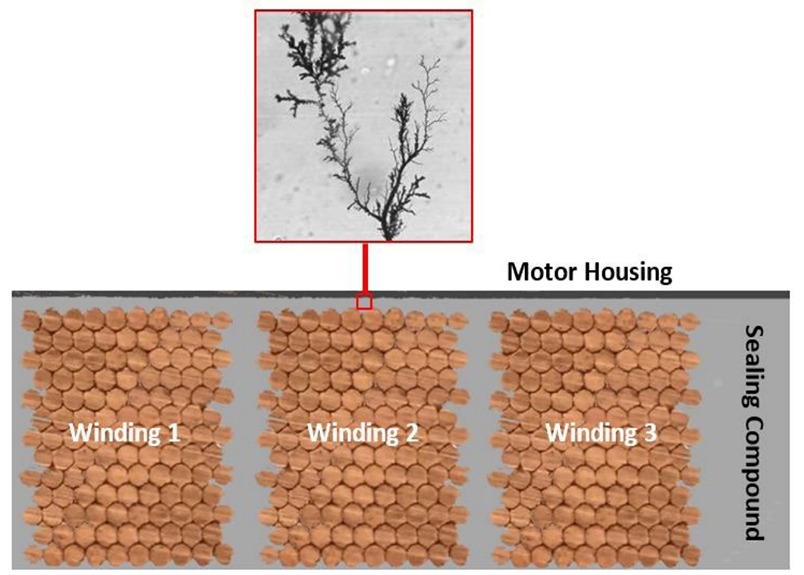
If the voltage is increased, the critical electric field strength is exceeded and a free electron is present, discharges occur. The larger the cavity, the more probable a partial discharge is. The symmetrical finger structures, as shown below by an electric drive, are very typical for cavity discharges.

However, the discharge of a cavity can also lead to several discharge structures (fingers). This depends on the geometry, field distribution, permittivity and other factors. The cavity discharges take
place at the greatest voltage change. The consequence of this partial discharge is a slow but continuous destruction of the still functional insulation. This continuous enlargement of the weak
spot inevitably leads to a complete breakdown of the electrical machine and thus to its destruction.
Partial discharges play an important role as a source of error in medium and high voltage systems and can affect almost any equipment or system in electrical power engineering. One of the most important elements in the design of electrical machines is the insulation of the windings to ensure fatigue resistance to partial discharges. Early detection in the development phase and the prevention of partial discharges is therefore essential and part of the quality of an electric drive to ensure a long service life.
Partial discharges play an important role as a source of error in medium and high voltage systems and can affect almost any equipment or system in electrical power engineering. One of the most important elements in the design of electrical machines is the insulation of the windings to ensure fatigue resistance to partial discharges. Early detection in the development phase and the prevention of partial discharges is therefore essential and part of the quality of an electric drive to ensure a long service life.
Source:
1 IEC; DIN EN 60270 (VDE 0434):2016-11, Hochspannungs-Prüftechnik, Teilentladungsmessung, 2016.
1 IEC; DIN EN 60270 (VDE 0434):2016-11, Hochspannungs-Prüftechnik, Teilentladungsmessung, 2016.