

 Contact Us
04/17/2024
The journey of our luggage: from baggage check-in to our holiday destination and back
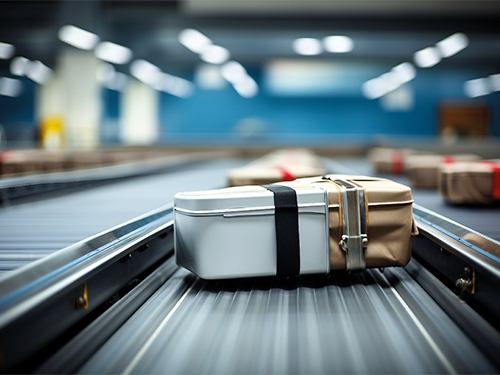 When we travel by plane these days, we attach great importance to punctuality and a comfortable journey. It is now taken for granted that we drop our luggage off at the counter and pick it up again on a carousel at our destination. Due to the high volume of passengers, baggage, and goods, logistics in the background of airport operations is key to ensuring that the baggage arrives together with its passengers.
Every item back to its owner - baggage logistics at airports:
When we arrive at the airport, we expect a simple check-in of our luggage at the counter. We are happy that we no longer must take care about transporting our bulky suitcase. There is no question in our minds that it will be automatically transported and loaded onto the right airplane. After arriving at our destination, we want to collect our luggage undamaged at the baggage reclaim - with as little wait time as possible. What is required in the background for this process is beyond our knowledge.
This is where intralogistics comes into its own. What typically has been associated with large industrial buildings and warehouses has long since become an integral part of airports and some large railway stations.
Once the luggage has been checked in at the counter, it is the airline's responsibility to transport all suitcases to the right gate at the right time and load them onto the right aircraft. Upon arrival at the destination, the luggage must be transported to the appropriate baggage claim area where its owner can collect it.
The volume of transport at international airports has risen steadily over the years and current forecasts predict that the volume of travelers will continue to increase. Over 550 aircraft take off from Germany's largest airport in Frankfurt every day. With approximately 150,000 passengers per day, around 88,000 pieces of baggage must be handled. That's over 22 million suitcases a year, which are received, loaded, transported, and then returned to their owners.
Early baggage check-in - but where to put it?
Around 20,500 suitcases can be transported per hour at modern airports. The routes to the corresponding gate are traveled at a transport speed of up to 18 km/h. In theory, a suitcase can be transported to any desired point on the airport premises in just 10 minutes.
However, the security checks required for baggage and passengers are becoming increasingly extensive and time-consuming due to the high security precautions. To avoid the resulting stress at check-in, many passengers hand in their luggage at the counter two to three hours before departure, or even check it in the evening before. Where to put baggage checked in so early? The only way to earn money with an aircraft is in the air, which is why airlines keep the ground time of their aircraft as short as possible. This, in turn, means that the time window for loading an aircraft is tight. Baggage that is checked in early therefore cannot be loaded onto the aircraft immediately and must be stored temporarily.
The challenge in storing and transporting baggage lies in its sorting and, on the other hand, in transport logistics, which ensures that the baggage reaches the designated gate on time.
There are various concepts for this, which are generally used in combination. One common approach, for example, is to distribute each piece of baggage in its own transport tray, which is transported through the airport via a rail system. With the help of a tilting movement, the luggage then reaches a chute, from where they are taken to a collection point for further distribution. By integrating such transport trays into a storage system, it is possible to store the baggage temporarily. Such systems are mainly used where luggage has to be individually checked and transported onwards.
As an alternative to the transport trough, a conventional conveyor belt can also be used to transport a large amount of luggage from A to B at high speed. This approach is used when many items of luggage must be transported long distances within an airport. Here too, tilt-tray sorters are used to supply different areas and transfer points. An intermediate solution is a circular track with anchored trays with a tilting function. In this system, a single piece of luggage is placed on each tray. The suitcases are distributed to various collection points via the round or oval "circular track" using the tilting function.
For even faster loading and unloading of the aircraft, luggage can be loaded into precisely fitting containers in the belly of the aircraft rather than individually. The time-consuming loading process takes place on the ground. As soon as the aircraft docks at the terminal, the entire container can be loaded in a time and space-optimized manner. Unloading is also quicker with the help of the containers. Using a tilting and sorting mechanism, the baggage items are taken out of the container onto a conveyor belt and can then be collected and transported to baggage claim. However, not all airports support this advanced technology yet.
The drive unit – a key component for transport and sorting
Whether trough, circular track, or conveyor belt technology - without the right drive, there is no way forward for the luggage. In modern baggage transport systems, both the transport and tilting movements are initiated by electric drives.
The top priority when using drive solutions in airport logistics is their reliability. With throughputs of several tens of thousands of items of baggage per day, a smooth process must be guaranteed. The drives used are therefore always networked via a fieldbus system. This means that the status of the drives can be requested and controlled by a higher-level control system. Remote maintenance and condition monitoring functions allow the drives to be analyzed and replaced in advance before an impending failure. What is known in industry under the buzzwords IIoT, Industry 4.0, and predictive maintenance has been used in airports for decades. Without these features, reliable operation could not be guaranteed and the immense volumes of baggage could not be handled.
There is also an increased requirement for surface protection of the gear motors, as they are often exposed to strongly fluctuating temperatures and other influences. Many airports are built in coastal areas. Salty sea air can have a particularly aggressive effect on the systems used outdoors and the motors installed in them. Depending on the area of application, ambient temperatures of -20°C to +40°C can also occur.
The electric gearmotors used here require good surface protection combined with a robust design. An integrated control system and various fieldbus systems also ensure simple and fast communication with a higher-level control system.
Dunkermotoren, a brand of AMETEK, can combine all these requirements in its smart series of brushless DC motors. Countless Dunkermotoren solutions are already ensuring the safe and reliable transport of baggage around the world to relieve the burden on airport operators, airlines, and passengers and make travelling more comfortable. Get a non-binding advice to find the suitable motor concept for your baggage transport system.
Downloads:
The journey of our luggage: from baggage check-in to our holiday destination and back (PDF)

Martina Jägler
Marketing Content Management and Lead Processing
Dunkermotoren GmbH
Allmendstraße 11
79848 Bonndorf, Germany
- Phone: +49 7703 930 314
- Email: Martina.Jaegler@ametek.com
Subscribe for press mailing list