Contact Us
The Perfect Gearmotor Solutions for Semiconductor Processing and Electronics Production
- Dunker gearmotors have been trusted for years across the entire value chain, from semiconductor manufacturing to electronics production and logistics management. Continuous innovation ensures our motors meet the unique challenges of the industry, delivering optimal performance for your applications.
- Whether it's transporting electronics, adjusting formats in the soldering process, or positioning, rotating, and storing circuit boards, our motors ensure reliability, precision, and dynamic performance in every step of the process.
- Dunkermotoren offers solutions for all rotary and linear adjustment needs, from simple linear motions to advanced, system-integrated applications in Industry 4.0 environments.

Semiconductor Manufacturing
Front-End Technology: Chip Production
In semiconductor component production, multiple layers are sequentially applied to a substrate in the form of a wafer. These layers are structured through a lithographic process, forming integrated circuits with conductor tracks, creating the semiconductor chips.
BLDC motors play a critical role in this process, enabling precise positioning of wafers and tools to ensure accuracy and efficiency in chip production.

Back-End Technology: Circuit Separation
Back-end production involves multiple critical process steps, including:
- Separating wafers into individual chips
- Assembling and wiring the microchips
- Producing housings and connections
Dunker motors play a vital role in this phase, providing speed-controlled operation and highly precise positioning. Accurate performance is essential to maximize the number of usable chips extracted from each wafer.

Electronics Production
The production of electronic assemblies typically follows a linear process, with each step building on the previous one until a fully assembled circuit board is completed. Early error detection is crucial to minimize costs, and appropriate testing methods are essential for identifying faults.
The manufacturing and testing steps required to produce a fully assembled PCB vary based on the product's complexity and value. Below is a simplified overview of the process sequence.
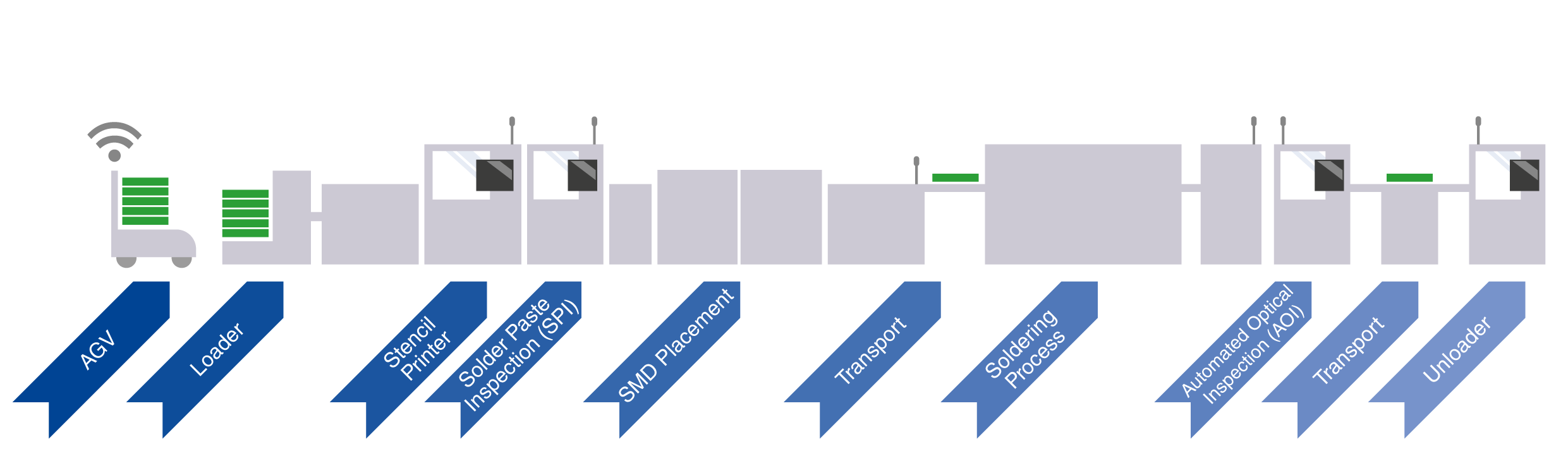
PCB (Un)Loader
The PCB (un)loader plays a crucial role in automating electronics production. It ensures that unloaded PCBs are fed into the process while assembled or processed PCBs are safely removed from the production line and organized for the next stage or storage.
DC motors provide precise and controlled movement during the (un)loading process, including the automatic stacking of PCBs into magazines, ensuring efficiency and reliability throughout the operation.

Stencil Printing
Stencil printing is the initial step in electronics production, where solder paste is applied to the PCB. As electronic products become smaller and more powerful, precision in this process is increasingly critical.
Dunker motors in stencil printers provide precise control over movement, positioning, and dosing, ensuring an even and accurate application of solder paste for optimal production quality.

Inspection (SPI, AOI, AXI)
SPI (Solder Paste Inspection): This step involves (3D) inspection of the applied solder paste to detect its position, height, and shape with precision.
AOI (Automated Optical Inspection): Solder joints on the PCB are examined for defects and deviations to ensure quality.
AXI (Automated X-ray Inspection): X-rays are used to inspect hidden solder joints and connections that are not visible externally.
DC motors in automated inspection machines provide precise control, enabling efficient and accurate inspection of solder joints and connections on electronic assemblies.

SMD Placement Machine
Surface-mount device (SMD) components are picked up from feed belts and accurately placed in their predetermined positions on the PCB. SMD placement machines play a vital role in ensuring the efficiency and quality of electronics production.
Dunker motors reliably transport PCBs into the pick-and-place machine, secure them precisely in place, and support the measurement process during component placement for optimal accuracy and performance.

Soldering Process
After all components are placed on the PCB, it undergoes the reflow soldering process. The PCB is heated, melting the solder paste to securely bond the components. Other soldering methods, such as selective and wave soldering, may also be used depending on the application.
Customers rely on cost-optimized dMove motors for efficient PCB transport. For more complex lifting applications or precise positioning of the fluxer, dPro motors provide the ideal solution. Additionally, STO (Safe Torque Off) ensures a safe and reliable system shutdown when needed.

Labeling
Labeling printed circuit boards is essential for identification, traceability, and quality assurance. This process requires extremely high precision to apply labels in tight spaces while maintaining short cycle times. As production speeds increase, so do the demands for accurate and efficient labeling.
Dunkermotoren's dMove and dPro motors offer precise control, along with customizable software solutions and customer-specific parameterization, ensuring optimal performance tailored to individual requirements.

PCB Transport & Handling
Automated PCB handling streamlines the production process, enhances efficiency, and ensures precision in managing PCBs.
Typical tasks include transporting, rotating, turning, lifting, distributing, aligning, and buffering. Dunker motors excel in these applications, with motor selection tailored to the specific requirements for torque control, speed control, and positioning accuracy.

Depaneling
Depaneling involves cutting PCBs with the highest precision, regardless of their material, size, or contour. Common methods include laser cutting, milling, and punching.
Dunker motors provide precise control over cutting movements, positioning, and other critical aspects of the depaneling process. Maintaining exact dimensions during PCB separation ensures consistent and accurate results.

Logistics Management
Storage and Buffering
Fully automated storage systems ensure materials are provided cost-efficiently and at the right time. Buffer solutions optimize the interface between workstations, reducing process times and improving overall efficiency.
Dunker motors facilitate precise lifting and positioning of blanks within storage systems, ensuring seamless and accurate material handling.

Transportation Between Lines
Materials and products are efficiently moved between production lines, either through fixed routes or dynamic pathways using AGVs (Automated Guided Vehicles) or AMRs (Autonomous Mobile Robots).
Dunker motors, paired with advanced Wheel Hub Gearboxes, are already a trusted solution in numerous intralogistics applications, ensuring reliable and precise transport operations.

From straightforward linear movements to advanced, system-integrated applications in Industry 4.0 environments, Dunkermotoren provides the perfect gearmotor solution for every customer in the semiconductor industry.
Here you can find out more about:
Motor Technology Solutions for Smart Electronics Manufacturing